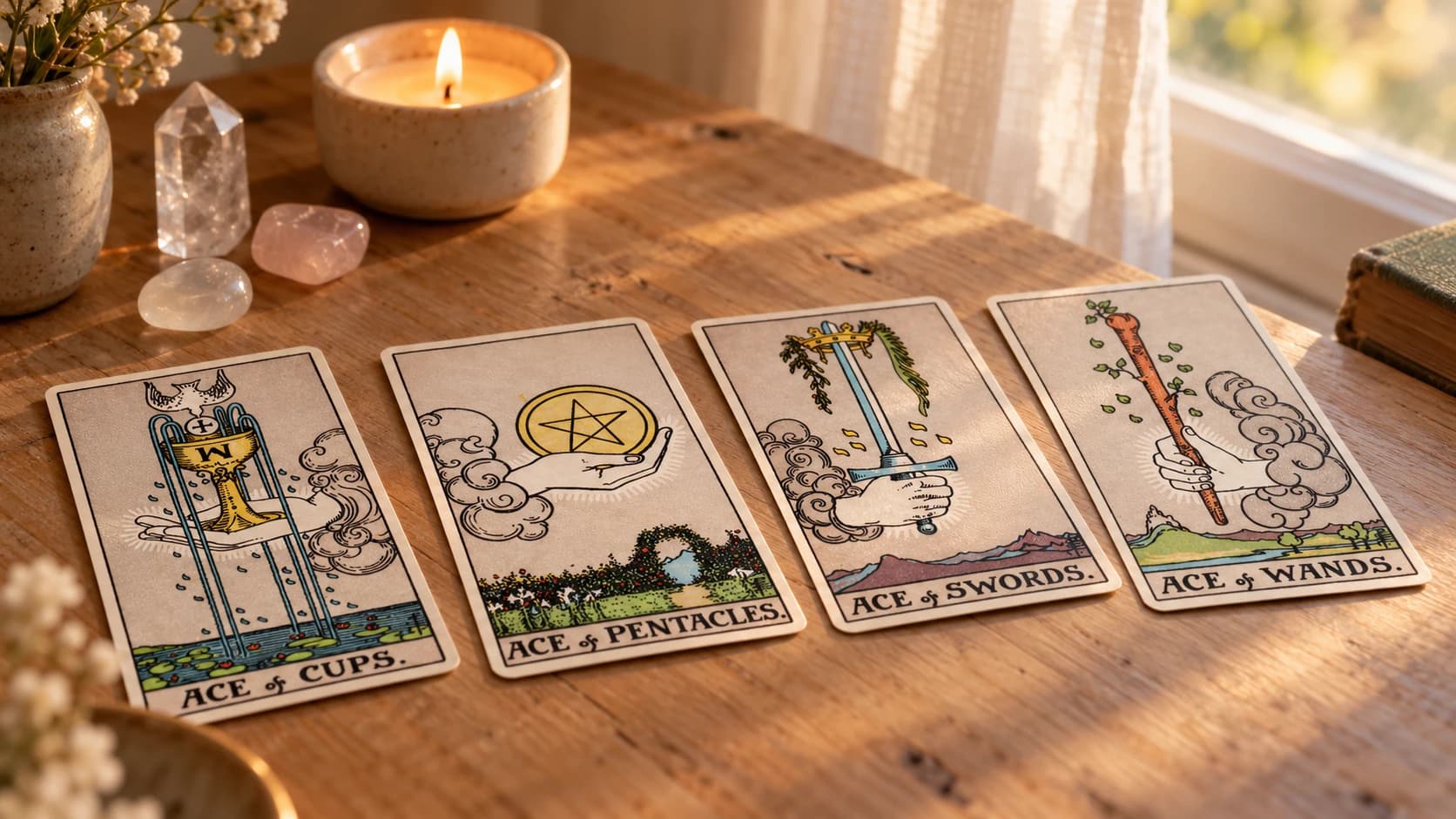
When you first explore a Tarot deck, 78 cards can feel like a lot to get acquainted with. The four suits offer a welcoming place to begin. Each has its own symbols, atmosphere, and themes, giving you a way to recognise connections between cards as you learn.
Cups introduce the world of feelings and relationships. Pentacles bring attention to practical life. Swords explore thoughts and communication, while Wands carry the energy of creativity and action.
Getting familiar with these four families makes the deck easier to navigate—and gives each card’s individual story a little more context.
Where the four suits fit in the deck
A standard Tarot deck has two parts: the Major Arcana and the Minor Arcana.
The Major Arcana consists of 22 cards, including The Fool, The Lovers, and The World. These cards have their own named identities and are commonly associated with broad life themes, significant transitions, and stages of personal development. They don’t belong to any of the four suits.
The remaining 56 cards make up the Minor Arcana. They are divided equally into Cups, Pentacles, Swords, and Wands, which often explore everyday situations and experiences.
Each suit contains 14 cards: Ace through Ten, followed by four court cards—Page, Knight, Queen, and King. The numbered cards develop different aspects of the suit’s themes. The court cards can represent people, qualities, or ways of approaching a situation.
Cups: feelings and connections
Element: Water
Cups are associated with emotions, relationships, intuition, and imagination. Like water, this suit can feel calm and welcoming, deep and mysterious, or difficult to contain.
You’ll often encounter themes of affection, friendship, belonging, and emotional fulfilment in Cups cards. The suit also makes room for disappointment, longing, and the experience of moving on.
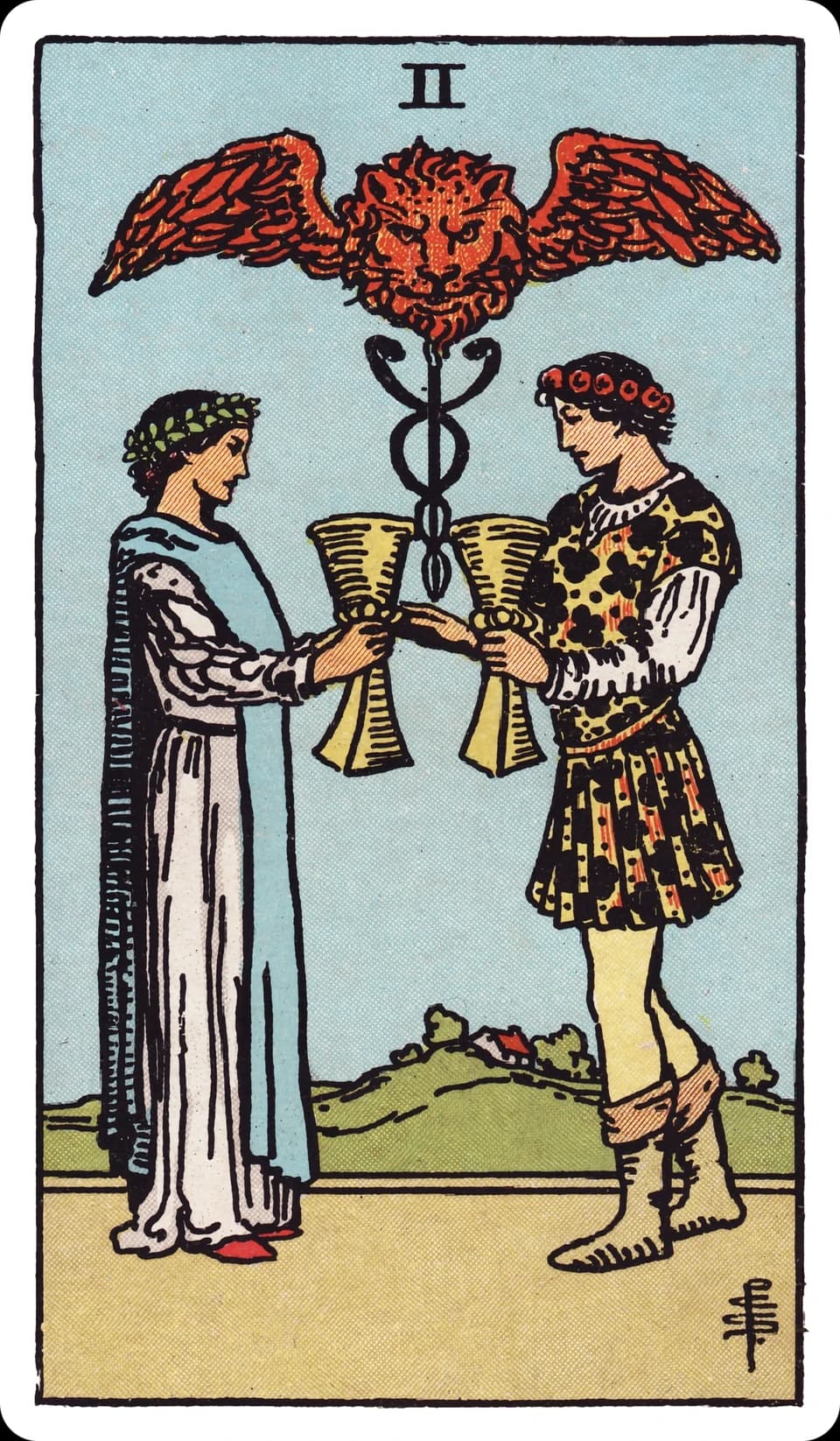
In the Rider–Waite–Smith deck, the Two of Cups shows two people facing one another and exchanging cups. It is commonly associated with mutual connection, partnership, and reciprocity.
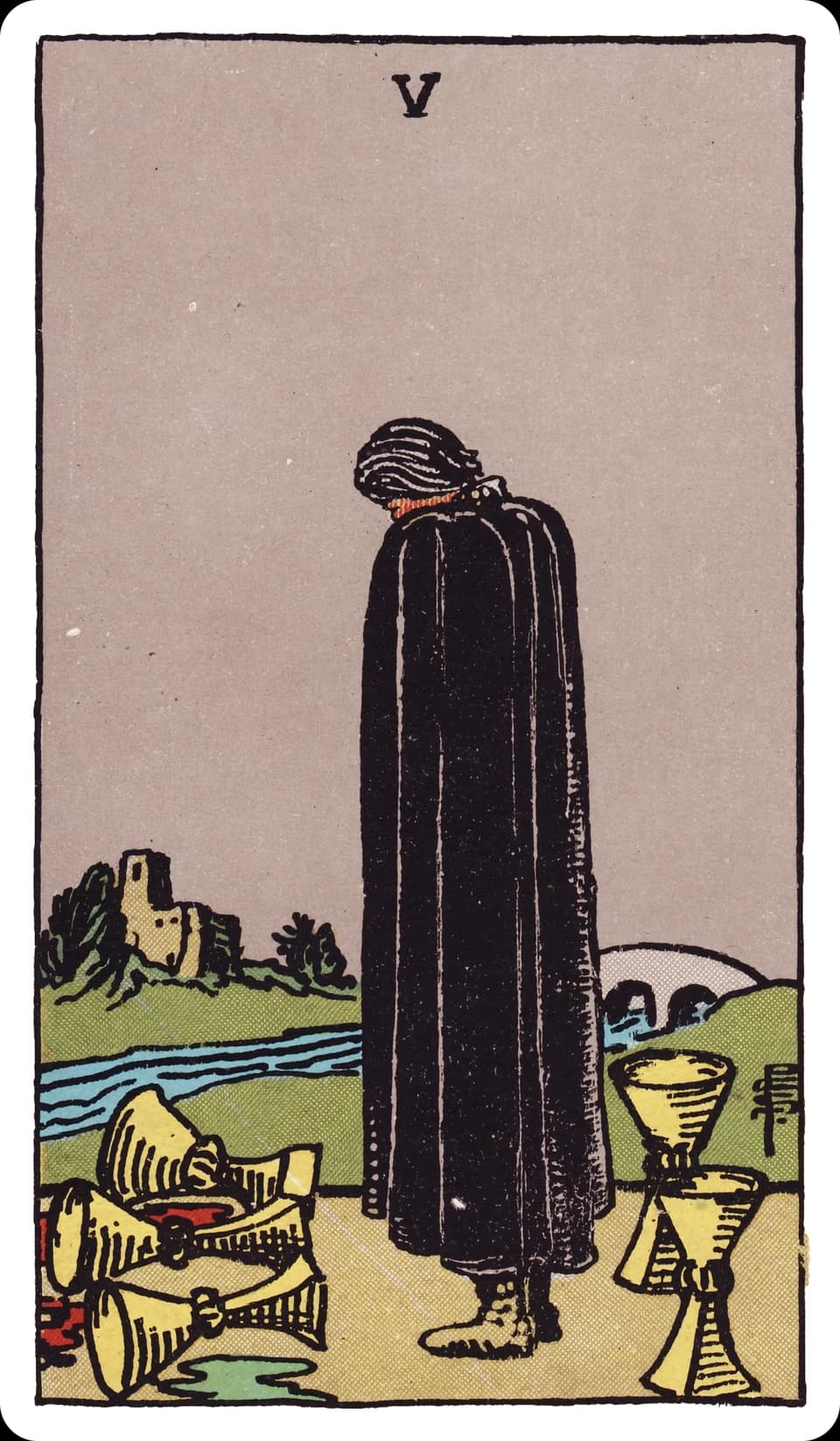
The Five of Cups brings a different mood. A figure looks towards three fallen cups while two remain standing nearby. Its themes include grief and disappointment, alongside the possibility of recognising what is still present.
Together, these cards show the range within the suit. Cups encompass the many ways we experience and respond to what matters to us.
Themes to remember: Feelings, relationships, intuition, connection, and care.
Pentacles: everyday foundations
Element: Earth
Pentacles are associated with the tangible parts of life: work, money, resources, home, and the effort involved in building something that lasts.
Their symbol is usually a five-pointed star enclosed in a circle, often pictured on a coin. Some decks call this suit Coins.
There is a grounded quality to Pentacles. They often concern what can be made, maintained, shared, or developed over time. Their meanings include security and abundance, as well as scarcity, uneven exchanges, and the need to use resources carefully.
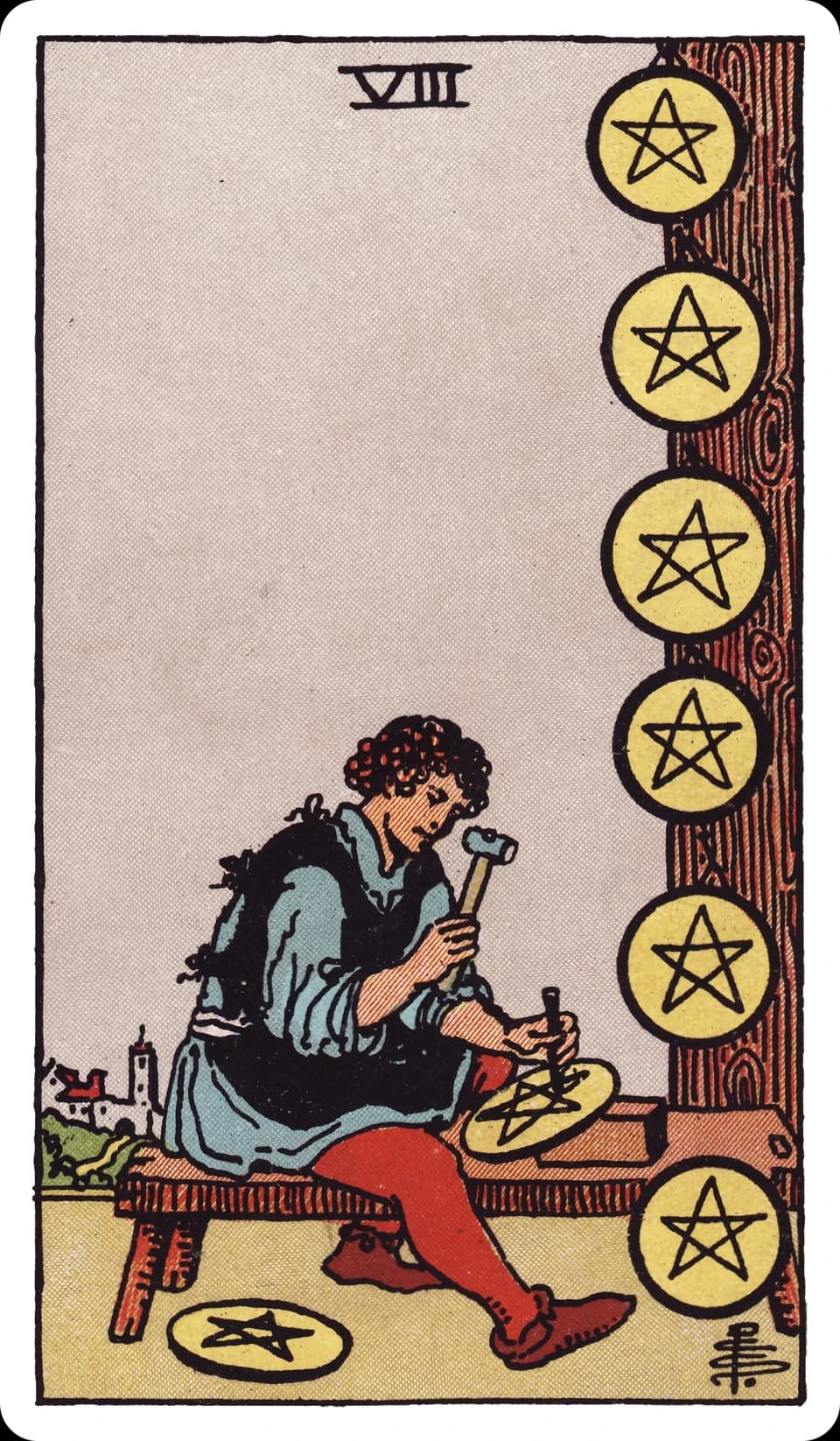
The Eight of Pentacles depicts a person concentrating on their craft. It is commonly linked with practice, dedication, and the gradual development of skill.
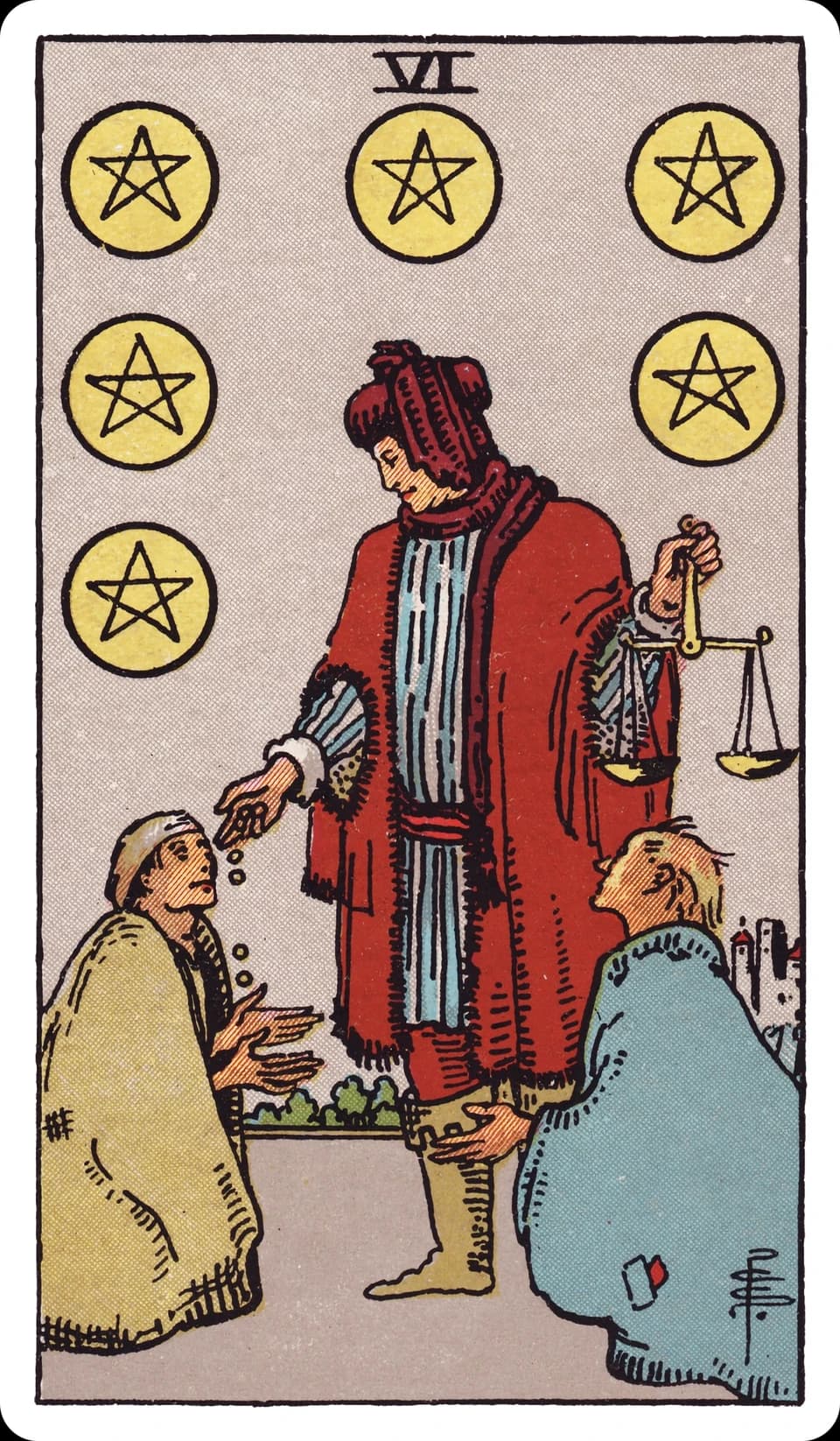
The Six of Pentacles shows an exchange of resources, with one figure holding a set of scales. It introduces themes of generosity, receiving help, and the balance of giving and taking.
Pentacles extend beyond financial matters. They also describe the time, attention, and practical support that make everyday life possible.
Themes to remember: Resources, work, home, stability, and steady effort.
Swords: thoughts and words
Element: Air
Swords are associated with the mind: ideas, beliefs, communication, judgement, and decisions. They often appear where clarity is needed or where different perspectives meet.
Some Swords cards have striking or uncomfortable imagery. Conflict, worry, and difficult truths are part of this suit’s territory. So are insight, honesty, and the ability to put something into words.
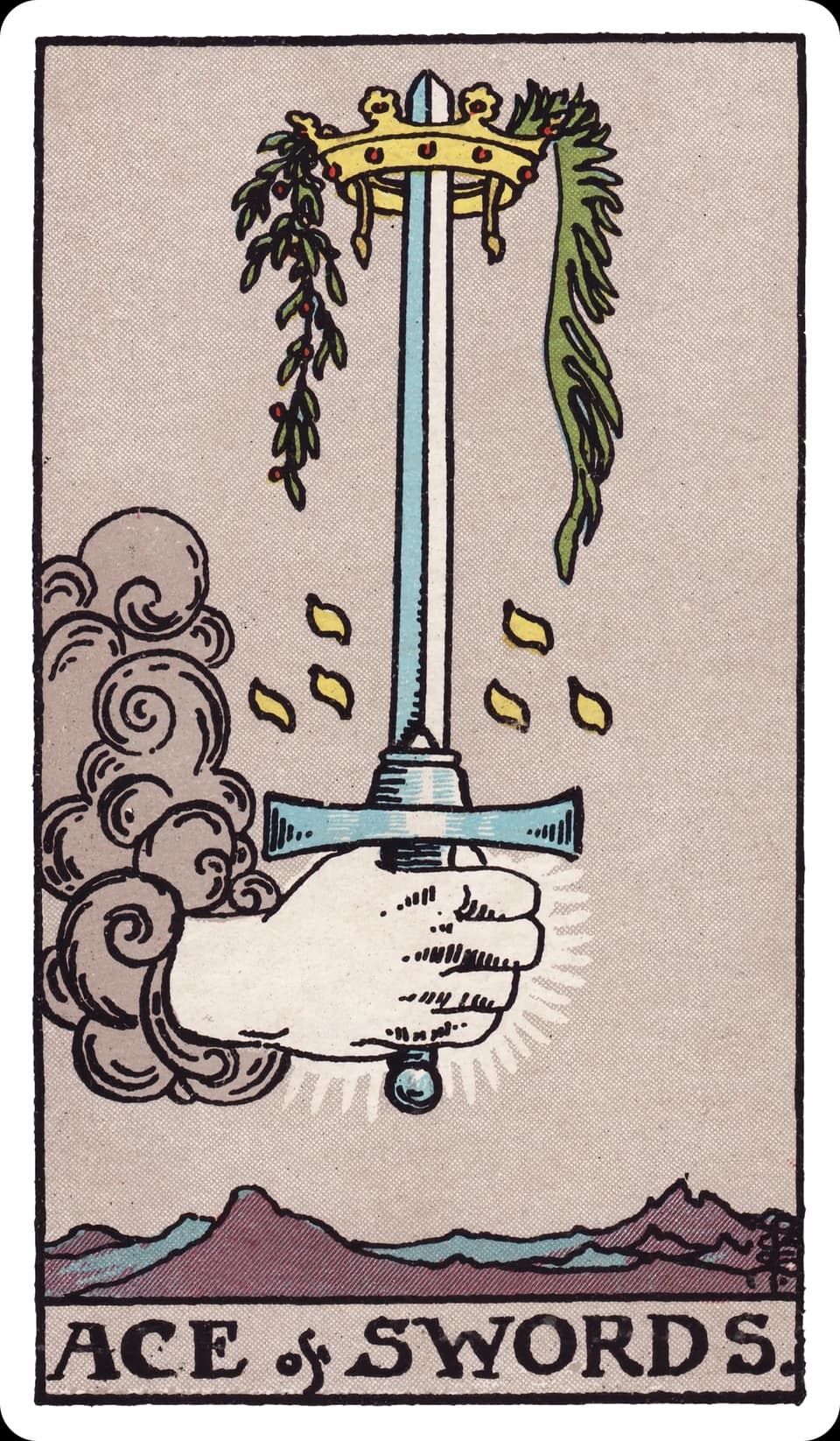
The Ace of Swords, with its upright sword held above the landscape, is commonly associated with mental clarity, a breakthrough, or a new understanding. It suggests the sharpness of an idea coming into focus.
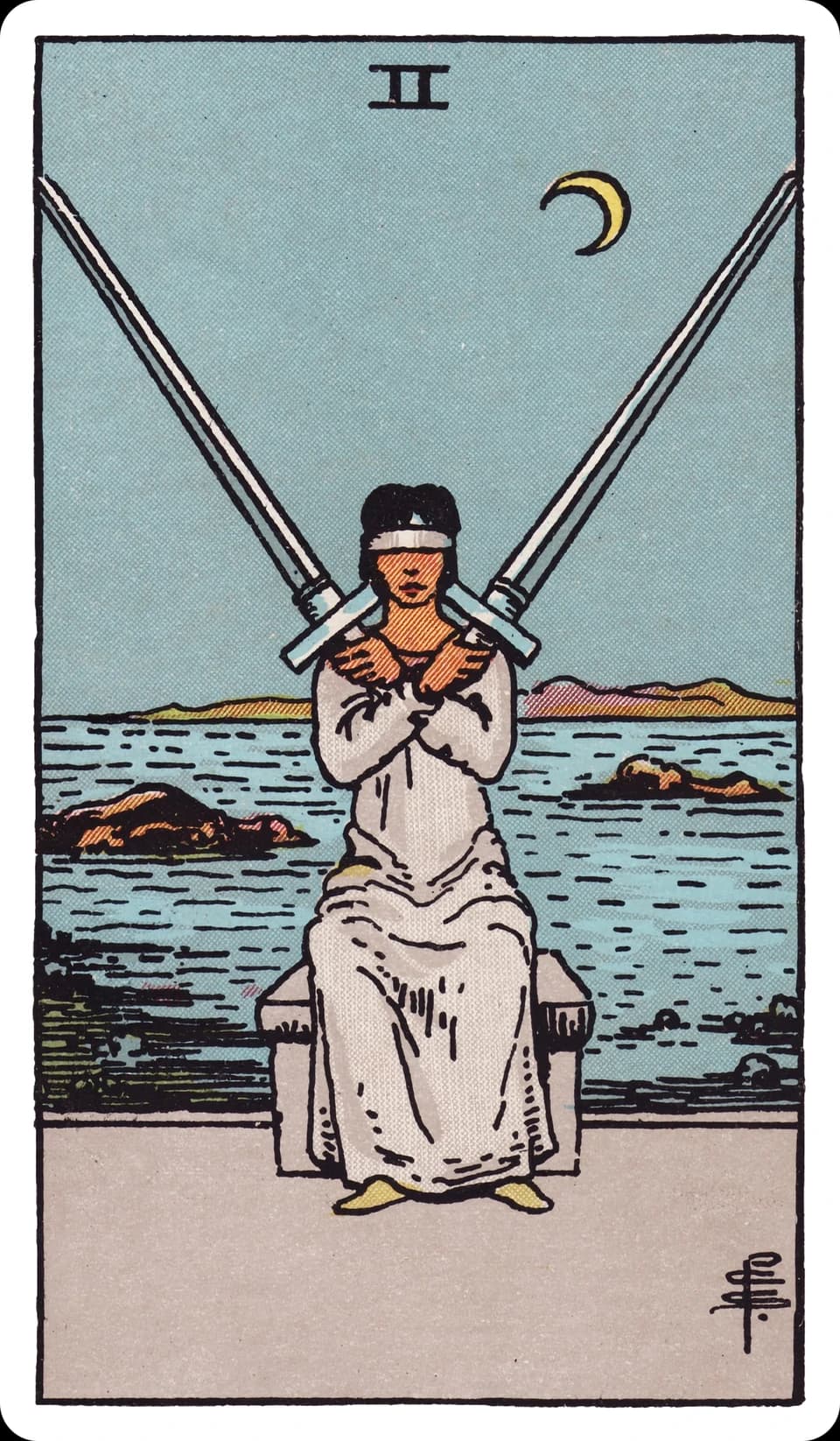
The Two of Swords shows a blindfolded figure holding two crossed swords. It is often connected with indecision, a stalemate, or the difficulty of weighing competing considerations.
The suit’s imagery gives it a distinctive edge, but Swords shouldn’t be read as automatically negative. Clear thinking and direct communication can be useful, even when the subject is challenging.
Themes to remember: Thoughts, communication, truth, decisions, and conflict.
Wands: energy and inspiration
Element: Fire
Wands are associated with creativity, motivation, ambition, and action. They bring a sense of movement: an idea taking shape, enthusiasm gathering, or a person deciding to begin.
In the Rider–Waite–Smith deck, Wands often appear as wooden staffs with fresh leaves growing from them. That hint of growth suits their connection with possibility and initiative.
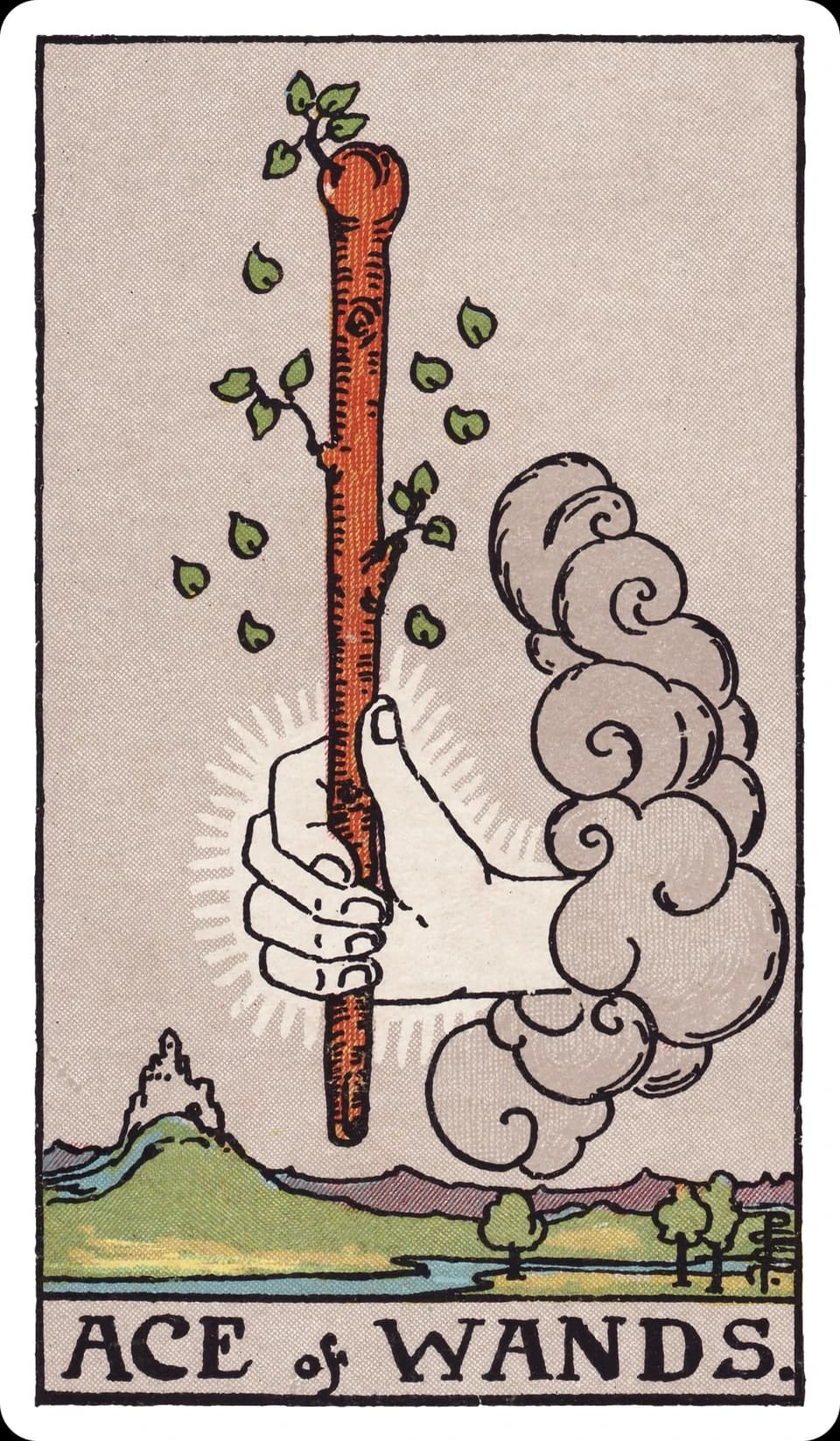
The Ace of Wands shows a hand holding a sprouting wand. It is commonly associated with inspiration, creative potential, and the energy of a new beginning.
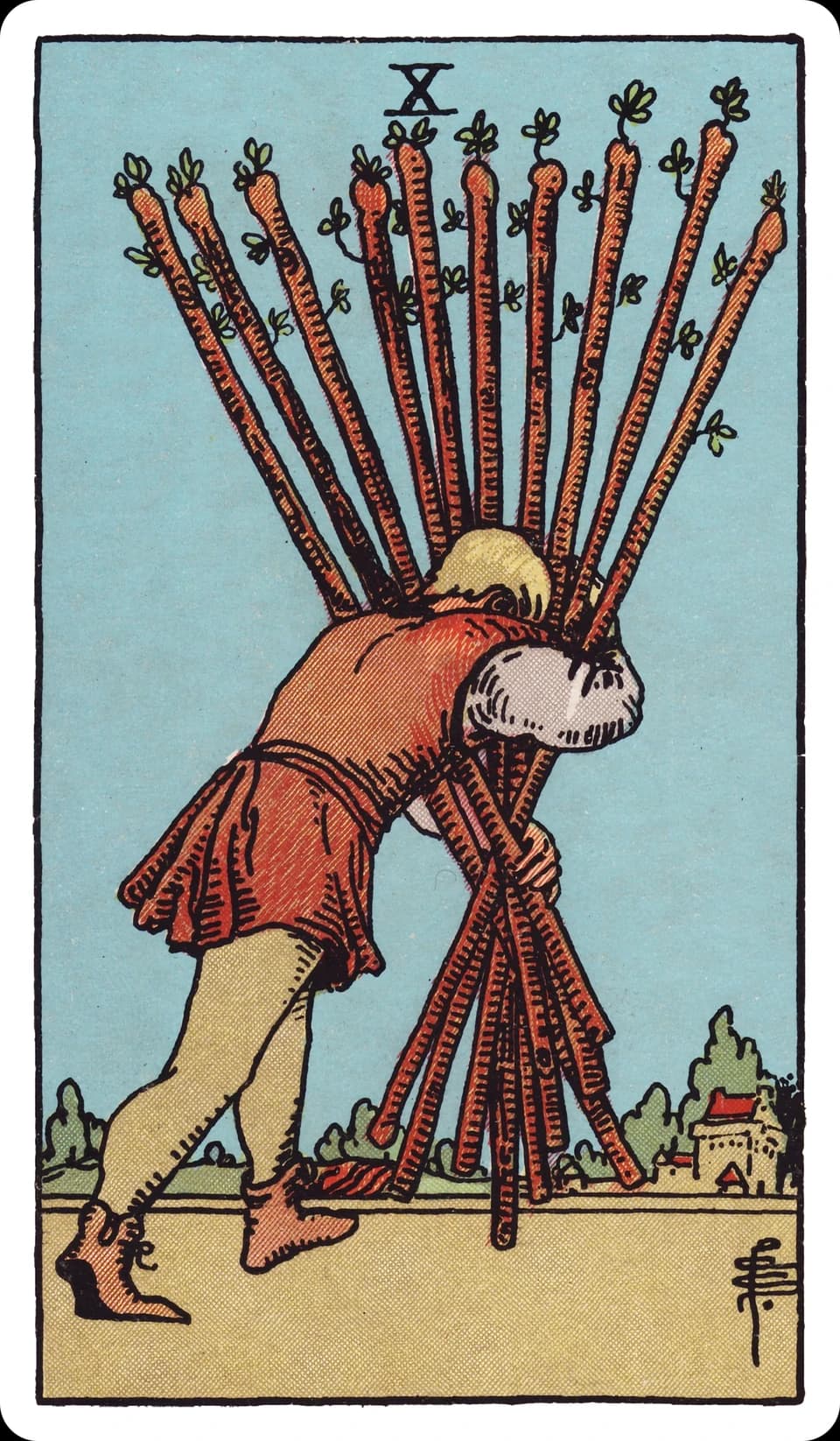
The Ten of Wands shows a figure carrying a large bundle of staffs. Its themes include responsibility, hard work, and the burden of taking on too much.
These two cards capture an important range within the suit: the excitement that gets something started and the demands that can follow. Wands explore both where energy comes from and how it is used.
Themes to remember: Creativity, enthusiasm, ambition, initiative, and action.
The four suits at a glance
| Suit | Element | Main themes |
|---|---|---|
| Cups | Water | Feelings, relationships, intuition, and connection |
| Pentacles | Earth | Work, resources, home, and stability |
| Swords | Air | Thoughts, communication, truth, and decisions |
| Wands | Fire | Creativity, motivation, ambition, and action |
These associations are a starting point. Each card has its own meaning, shaped by its number or court role, its imagery, and the context of the reading. A relationship question might involve the communication of Swords or the practical commitments of Pentacles as readily as the emotions of Cups.
Every suit contains moments of ease and difficulty, beginnings and endings, movement and hesitation. Learning their shared themes helps you recognise the family resemblance while leaving room for each card’s particular story.
When you’re ready to get to know the cards individually, explore all 78 Tarot card meanings at Taromi, including their upright and reversed interpretations.