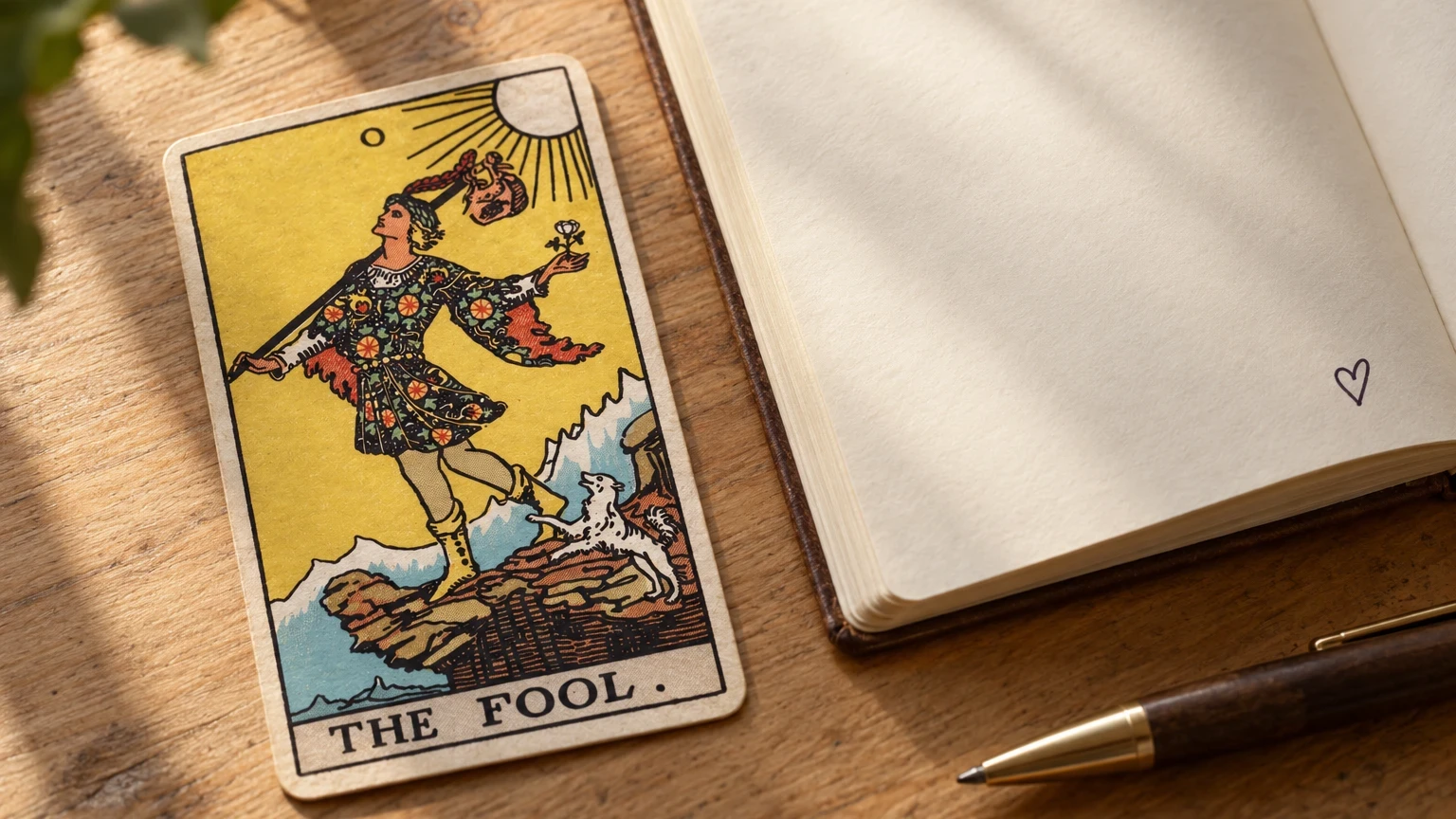
Some weeks pass so quickly that you barely notice what has changed. You finish something difficult and move straight to the next task. An interest becomes a regular part of your life. A routine that once worked starts to feel awkward.
A full moon Tarot ritual offers a moment to notice these things.
With a few cards and a notebook, you can recognise what is going well, consider what might benefit from an adjustment, and choose where you would like to direct your energy next.
That might mean continuing something you love, taking it further, or making room for a completely different curiosity.
Why use the full moon as a moment to reflect?
The Moon moves through its phases in a cycle lasting about 29.5 days. At the full moon, its sunlit face appears fully illuminated from Earth.
For this practice, that illumination offers a simple metaphor: looking more closely at your life.
You can approach the ritual spiritually, or use the full moon as a recurring reminder to check in with yourself. The cards provide images to think with, while your own experiences give the reading its context.
Celebrate, Adjust, Next
This full moon Tarot ritual follows three simple questions:
| Step | Question |
|---|---|
| Celebrate | What is going well that I want to keep making room for? |
| Adjust | Where could a small change make things easier or more meaningful? |
| Next | Where would I like to direct my energy next? |
Begin by appreciating what is working. Then consider whether anything could use a small adjustment. Finally, make room for what comes next, whether that means continuing something you enjoy, taking it further, or trying something new.
What you’ll need
Keep it simple:
- A Tarot deck
- A notebook or a sheet of paper
- A pen
- Around 15 minutes of quiet time
Choose somewhere comfortable. A clear corner of the kitchen table is enough. If soft lighting, a cup of tea, or a view of the evening sky helps you settle in, include it.
For this reflective practice, an evening around the full moon is fine. You don’t need to organise your schedule around its exact timing.
Begin with your own experience
Divide your page into three sections: Celebrate, Adjust, Next.
Before drawing any cards, write a brief answer to each question. Think about the past few weeks and include whatever feels relevant: work, relationships, hobbies, home life, or the small details of your days.
Then shuffle your deck and draw one card for each section, placing them in a row.
For each card, ask:
What does this image help me notice about my answer?
You might recognise something immediately. You might find an unexpected connection, or disagree with your first interpretation. Write down what comes up without forcing the image to fit.
Card 1: Celebrate
What is going well that I want to keep making room for?
Start with something you appreciate.
It could be a finished project, a friendship you have been tending, or a habit that makes your mornings easier. It could be something you enjoyed without needing to achieve anything at all.
Look at your card. What catches your attention? A person receiving help? Someone absorbed in their work? A scene of rest, movement, or companionship?
Consider whether the image draws your attention to something behind the experience. Perhaps a good result depended on asking for support. Perhaps an enjoyable afternoon happened because you left some time unplanned.
Try finishing these sentences:
- I’m glad I made time for…
- Something I want to give myself credit for is…
- I would like to keep making room for…
Celebrating an experience helps you recognise that it is worth keeping.
Card 2: Adjust
Where could a small change make things easier or more meaningful?
This question invites you to look at the way something fits into your life.
An activity you enjoy might need a more convenient time. A responsibility might become more manageable with help. An expectation might need to soften.
Return to your written answer, then look at the card. Does anything in the scene suggest effort, balance, support, boundaries, or a different pace?
Begin by naming the difficulty, then consider a small change you could try.
For example: “My phone distracts me while I read. I could leave it in another room.”
That gives you both an observation and a possible adjustment. You can try it and see whether it helps.
You might write:
- I’ve noticed that… so I could try…
- This would feel easier if…
- One expectation I could reconsider is…
You may also find that nothing needs changing right now. You can acknowledge that and move on.
Card 3: Next
Where would I like to direct my energy next?
Give yourself room to consider what you actually want.
You might want to continue something that feels good, develop a skill, take a bigger step, or explore something entirely new. Your answer does not have to solve an issue from the previous section.
Look at the card as a starting point for possibilities. What interests you about it? Does it bring to mind an activity, a quality, or an area of life you would like to give more attention?
Try asking:
- What would I like to continue or deepen?
- Is there a next step I feel ready to take?
- What am I curious about, even if it seems unrelated?
Then consider what making room for that choice could look like. You might block out a little time, talk to someone, look up a class, or choose a piece of work you would like to finish.
Continuing something you enjoy is a valid direction. It doesn’t have to become a bigger project to deserve space in your life.
What this might look like
Your next step might build on what’s working, take it further, or lead somewhere entirely new.
| Example | Celebrate | Adjust | Next |
|---|---|---|---|
| Continue something you enjoy | I’ve enjoyed reading in the evenings. | My phone distracts me while I read. I could leave it in another room. | I’ll set aside 20 minutes after dinner twice this week and let my family know I’d like some quiet reading time. |
| Take it further | I’ve been writing regularly and enjoying it. | I keep editing before finishing a draft. I could get the whole piece down before revising. | I’d like to share my writing publicly. I’ll choose one piece to finish and publish as my first blog post. |
| Try something new | I’ve settled into my new job and feel more confident. | I check work messages unnecessarily in the evening. I could turn off notifications after work. | I’m curious about pottery. I’ll look for a local beginner class and see whether there’s a session I can try. |
The writing example could take another direction, too. You might want to submit your piece to a magazine or an online publication. A practical first step would be to find one that publishes the kind of writing you enjoy and read its submission guidelines.
These examples are possibilities rather than a checklist. Your answers can be smaller, less certain, or still taking shape.
Close with one small next step
Read your notes and choose one action you would like to try first. You don’t have to act on every idea from the reading.
Make it specific enough to recognise when you have done it: leave your phone in another room for one evening, set aside time to finish a draft, or look up a local class.
You can frame it as an experiment:
I’ll try this and notice how it feels.
Date your page so you can return to it. At your next check-in, consider what you enjoyed, what helped, and whether you want to continue.
If a card feels unfamiliar, explore Taromi’s Tarot card meanings. Let the descriptions support your observations, and leave room for questions you haven’t answered yet.
A ritual you can return to
Your full moon Tarot ritual does not need to produce a new plan every month.
Sometimes it will help you recognise that you want more of what you already have. Sometimes a small adjustment will be enough. Sometimes you will discover that you are ready to follow a new interest.
Let the practice give you a little time to notice where you are, appreciate what matters, and choose what deserves your attention next.
This reflection structure was inspired by the Plus, Minus, Next exercise in Anne-Laure Le Cunff’s book Tiny Experiments. We’ve adapted it into Celebrate, Adjust, Next, using Tarot imagery as an additional prompt for reflection.