Perhaps there’s a sketchbook you’d like to open again. You miss the pleasure of looking closely enough to draw something, even the curve of a mug handle while your coffee cools. Five minutes at the kitchen table would be a lovely place to begin.
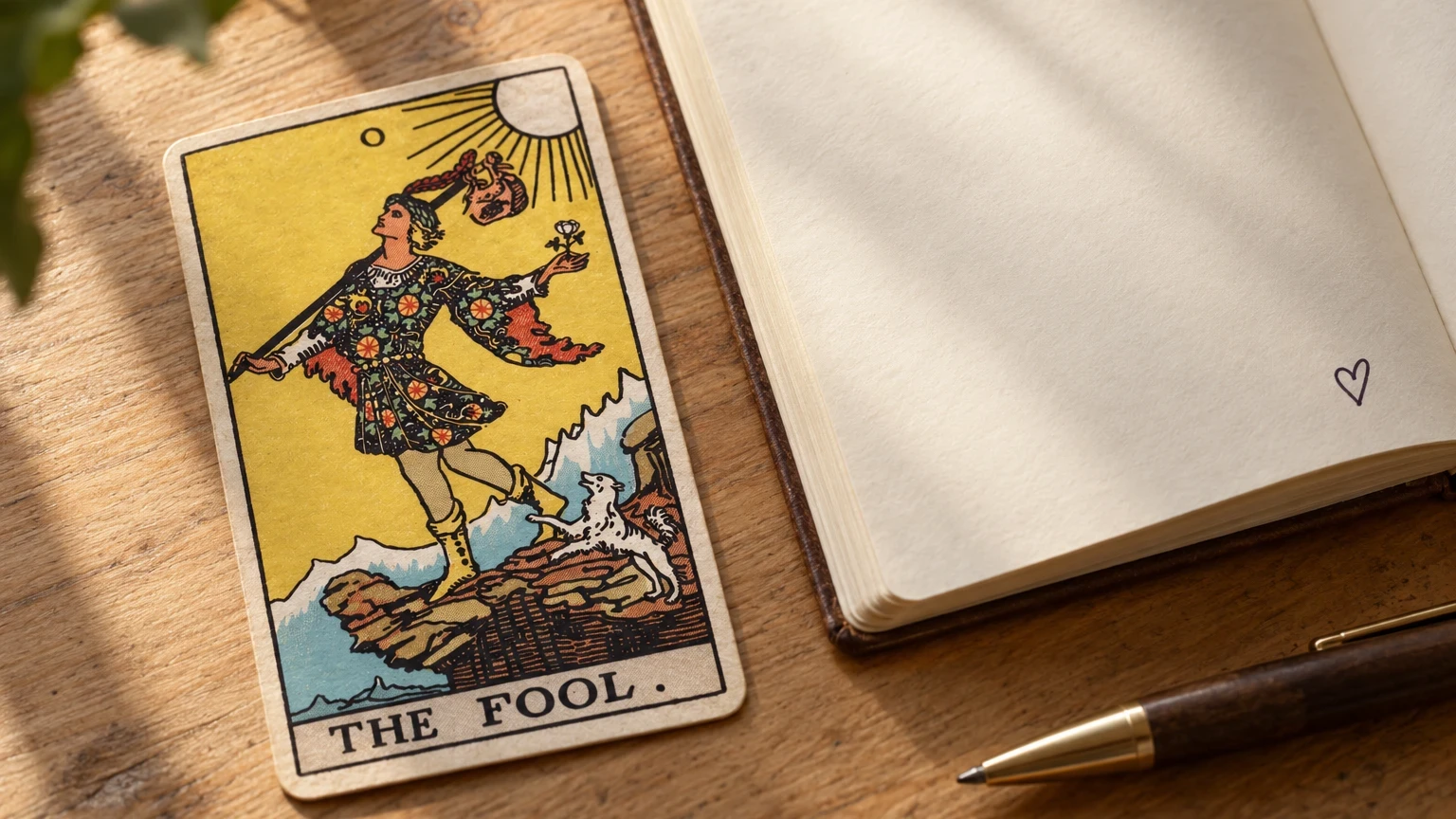
A new moon Tarot ritual gives you time to follow a thought like that. With three cards and a notebook, you can name something you want to begin or return to, consider what would help, and choose a first step that fits into your day.
How people welcome a lunar month
A lunar month begins at the new moon, when the Moon is hidden from view. A few days later, a thin crescent appears in the evening sky.
In ancient Greece, the first day of the lunar month was called Noumenia, meaning “new moon”. Households welcomed the month together, and people who follow Greek religious traditions still mark the day with a shared meal or a small offering.
Many people also use the new moon to set an intention or begin a project. This ritual follows that idea, with three Tarot cards and a notebook.
Choose any quiet moment around the new moon. In November 2026, it falls on November 9 at 07:02 UTC.
Intention, Support, First step
| Card | Question |
|---|---|
| Intention | What would I like to begin or return to? |
| Support | What would help me make room for it? |
| First step | What is one small step I’d enjoy taking toward it? |
Set aside about fifteen minutes with your deck, a notebook, and a pen. Date the page and write a line of your own beneath each question before drawing any cards.
Then shuffle and lay three cards in a row, one for each question. For each card, pick out a detail that catches your eye. What does it add to the answer you wrote? If the image takes your thoughts somewhere unexpected, follow that association for a line or two.
Card one · Intention
What would I like to begin or return to?
Think about the experience behind your intention. “I’d like to draw again” might mean spending a quiet morning with a pencil. It might mean taking a class because you miss making things alongside other people. The difference matters when you choose what to do next.
Look at the first card. Which part of the picture comes closest to what you want from the experience? Try finishing the sentence “What I’d enjoy about this is…”
Card two · Support
What would help me make room for it?
Picture an ordinary day and consider where your intention might fit. A sketchbook beside the coffee cups can be easier to pick up than one tucked away in a drawer. If you look forward to company, a standing invitation to draw with a friend might suit you better.
Look at what’s within reach on your card: a tool, a place, or another person. Which of these could help you, too? Write down one support you could arrange for yourself.
Card three · First step
What is one small step I’d enjoy taking toward it?
Look back at your intention and the support you wrote down. What could you do in the next few days, with that support in place? If you’d like to draw again and you’ve left a sketchbook by the coffee cups, your first step might be five minutes sketching the handle of your favourite mug. If you’d like more time with a friend, it might be suggesting a day for a walk.
Let something specific in the third card shape your choice. If your eye goes straight to a flower, for instance, you already have a subject for your first sketch. Write down what you’d like to try and when you’ll have the opportunity.
What a reading might look like
Suppose your first note says, “I’d like to feel close to an old friend again.” Here’s how three cards might help you turn that wish into an invitation.
| Position | What you notice | What you might write |
|---|---|---|
| Intention · Six of Cups | One figure offers another a cup filled with flowers. It reminds you of the walks you took with your friend and how often they stopped to identify a plant. | “I miss having enough time together to notice little things.” |
| Support · Three of Pentacles | A craftsperson turns towards two people holding a plan. Planning together catches your attention. | “Our calendars are different. I could suggest two afternoons and let my friend choose.” |
| First step · Page of Cups | A fish peeks out of the Page’s cup. The surprise makes you smile and brings back your friend’s sense of humour. | “I’ll send a photo of something from our old walking route and ask if they’d like to go again.” |
Someone else could draw the same cards and think about a creative project or a family tradition. What matters here is the detail that helps you say what you want in your own words. You can explore the illustrations in Taromi’s card meanings.
Return at the full moon
Leave a few lines beneath your reading. At the next full moon, read your original answers before adding anything. Which detail do you remember? What did you enjoy enough to try again? If your interest has changed, write down what caught your attention instead.
For the November 2026 cycle, the full moon falls on November 24 at 14:53 UTC. You can use Taromi’s companion full moon spread to celebrate what went well, make an adjustment, and decide what comes next.
You might have a new walking date on the calendar, or one small sketch in the margin of your notebook. Let that experience be the first thing you write about when you come back.